Class 11 Physics · Mechanical Properties of Solids
Elasticity worksheet for Class 11 Physics
25 practice questions on Elasticity for Class 11 Physics (Mechanical Properties of Solids), from Priya Jain (M.Sc. Physics, B.Ed.). Open the worksheet to view, print or download it, or read the questions below.
Section A · Multiple Choice
Choose the correct option. Questions 1–21
- 1
The possible value of Poisson’s ratio () for any material can be:
- a Between 0 and 0.5
- b Between 0.5 and 1.5
- c Between −1 and −2
- d Between 0.5 and −1
- 2
Shearing strain is equivalent to:
- a An extension strain
- b A compressive strain
- c The sum of mutually parallel expansion and contraction strains
- d The sum of mutually perpendicular expansion and contraction strains
- 3
When a wire is twisted, the strain produced in it is:
- a Normal strain
- b Longitudinal strain
- c Lateral strain
- d Shearing strain
- 4
If two identical balls, one made of ivory and the other made of clay, are dropped from the same height onto the floor, then:
- a The ivory ball will bounce to a higher height
- b The clay ball will bounce to a higher height
- c Both balls will bounce to the same height
- d The ivory ball will not bounce at all
- 5
Which of the following is the most elastic material?
- a Glass
- b Quartz
- c Steel
- d Rubber
- 6
The following four wires are made of the same material. On applying the same tension, which one will have the maximum increase in length?
- a Length 50 cm, diameter 0.5 mm
- b Length 100 cm, diameter 1 mm
- c Length 200 cm, diameter 2 mm
- d Length 300 cm, diameter 3 mm
- 7
A wire of length and cross-sectional area is made of a material whose Young’s modulus is . If an extension is produced in its length, the work done is:
- a
- b
- c
- d
- 8
Copper wires are more easily drawn out than iron wires because:
- a Copper is a good conductor of heat
- b The resistance of copper is less
- c The modulus of rigidity of copper is high
- d The Young’s modulus of copper is high
- 9
In a metallic wire, if the stress is and the Young’s modulus is , then the energy stored per unit volume is:
- a
- b
- c
- d
- 10
Elasticity is a property of matter that is:
- a Molecular in nature
- b Electromagnetic in nature
- c Nuclear in nature
- d Gravitational in nature
- 11
The relation between , and is:
- a
- b
- c
- d
- 12
The relation between , and is:
- a
- b
- c
- d
- 13
If the radius of a wire and the force applied to it are both doubled, then the increase in its length will become:
- a Four times
- b Two times
- c Unchanged
- d Half
- 14
The Young’s modulus of elasticity of a wire material is N/m². If the strain produced in it is 0.15, then the applied stress (in N/m²) will be:
- a
- b
- c
- d
- 15
The dimensions of strain are the same as those of which of the following quantities?
- a Stress
- b Modulus of elasticity
- c Angle
- d Pressure
- 16
When a weight is suspended from one end of a wire, the wire gets stretched. The potential energy per unit volume of the wire in terms of longitudinal strain and Young’s modulus will be:
- a
- b
- c
- d
- 17
The upper end of a wire of radius 4 mm and length 100 cm is clamped, and the other end is twisted by . The shearing angle will be:
- a
- b
- c
- d
- 18
The Young’s modulus of a given substance is 2.4 times its modulus of rigidity. Its Poisson’s ratio will be:
- a 2.4
- b 1.2
- c 0.4
- d 0.2
- 19
On applying a load to a wire, its length increases by 3 mm. The extension in another wire of the same material and same length, but whose radius is half, under the same load will be:
- a 12 mm
- b 0.75 mm
- c 6 mm
- d 15 mm
- 20
How much force is required to stretch a steel wire of cross-sectional area 1 cm² to 1.1 times its length?
- a N
- b N
- c N
- d N
- 21
A wire of length and cross-sectional area has a Young’s modulus of elasticity . If the length of the wire is doubled and the cross-sectional area is halved, then the Young’s modulus of elasticity of the wire will become:
- a
- b
- c
- d
Section B · Short Answer & Numericals
Show all steps. Questions 22–25
- 22
The edge of a solid copper cube is 10 cm. When a hydraulic pressure of Pa is applied to it, its volume contracts by 0.06 cm³. Find the bulk modulus of copper.
- 23
Two wires A and B of different metals, having the same radius and equal length, are joined together to make a long wire. By fixing one end of it and applying a force on the other end, the elongation in the length of this composite wire is 4 cm. If , find the change in length of wire B. ( = Young’s modulus of elasticity)
- 24
Find the work done per unit volume to increase the length of a wire by 1%, having Young’s modulus and a cross-sectional area of 1 mm². ( N/m²)
- 25
What is the density of water at a depth where the pressure is 80.0 atm, given that its density at the surface is kg m?
Formula Sheet · Elasticity
Quick revision
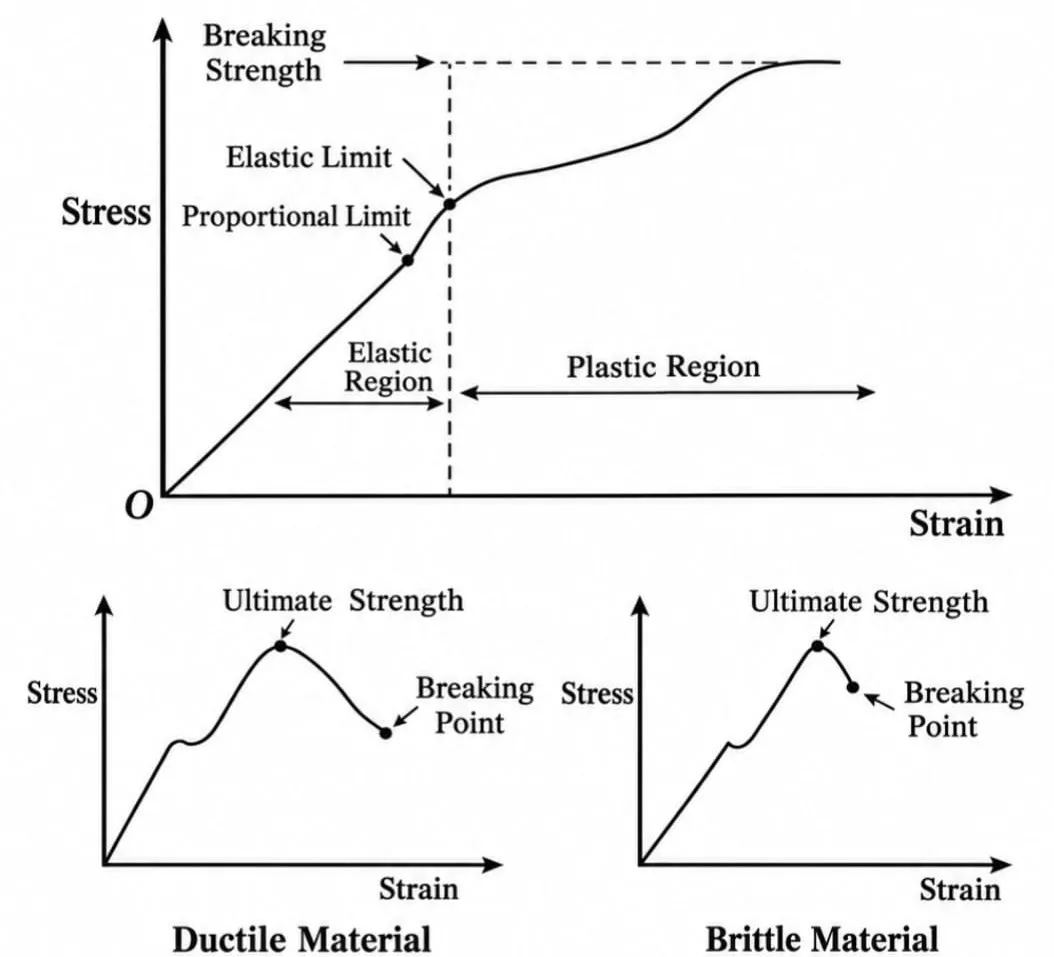
Hooke’s law & stress–strain curve
| Hooke’s law (within elastic limit) |
|---|
Young’s modulus ()
| Definition | |
|---|---|
| Wire of length , radius , load | |
| Elongation due to the wire’s own weight | |
| Force constant of the wire | |
| Actual length of the wire ( found from these) | |
| Work done in stretching the wire | |
| Stored energy in a wire |
Bulk modulus ()
| Definition | |
|---|---|
| Isothermal elasticity modulus | |
| Adiabatic elasticity modulus | |
| Density of compressed liquid | |
| Compressibility |
Modulus of rigidity (), Poisson’s ratio () & relations
| Modulus of rigidity | |
|---|---|
| Poisson’s ratio | |
| Change in volume | |
| Theoretical value | |
| Practical value | |
| Relation between , and | |
| Relation between , and |
Try a class first. It’s free.
Book a free trial class and see how Priya teaches before you decide. No commitment.
Book a free trial class