Book Free Trial

Priya Physics Class

Class 9–12 Physics · CBSE, Rajasthan & state boards

Practice worksheet · Class 11 Physics

Vectors

Scan for more
Name: Class: Date: Score: / 30

Class 11 Physics · Motion in a Plane

Vectors worksheet for Class 11 Physics

30 practice questions on Vectors for Class 11 Physics (Motion in a Plane), from Priya Jain (M.Sc. Physics, B.Ed.). Open the worksheet to view, print or download it, or read the questions below.
26 MCQs 4 numericals Formula sheet Free PDF · 4 pages

Section A · Multiple Choice

Choose the correct option. Questions 1–26

  1. 1

    Which of the following is a vector quantity?

    1. a Work
    2. b Displacement
    3. c Power
    4. d Time
  2. 2

    Two forces of 6 N and 8 N act on a particle in mutually perpendicular directions. The magnitude of the resultant force will be:

    1. a 14 N
    2. b 12 N
    3. c 10 N
    4. d 7 N
  3. 3

    If the magnitude of the resultant of two vectors equal in magnitude is also equal to their individual magnitude, then the angle between the two vectors will be:

    1. a 2π/32\pi/3
    2. b 2π/22\pi/2
    3. c π/3\pi/3
    4. d 00
  4. 4

    If a^\hat a is a unit vector in the direction of the vector A⃗\vec A, then:

    1. a a^=∣A⃗∣ A⃗\hat a = |\vec A|\,\vec A
    2. b a^=∣A⃗∣/A⃗\hat a = |\vec A|/\vec A
    3. c a^=A⃗/A⃗\hat a = \vec A/\vec A
    4. d a^=A⃗/∣A⃗∣\hat a = \vec A/|\vec A|
  5. 5

    Find pp if a⃗=p ı^+0.3 ȷ^+0.4 k^\vec a = p\,\hat\imath + 0.3\,\hat\jmath + 0.4\,\hat k is a unit vector.

    1. a 0.50.5
    2. b 0.530.5\sqrt{3}
    3. c 0.520.5\sqrt{2}
    4. d 0.750.75
  6. 6

    If a unit vector is represented by (0.5 ı^+0.8 ȷ^+c k^)(0.5\,\hat\imath + 0.8\,\hat\jmath + c\,\hat k), then the value of cc is:

    1. a 11
    2. b 0.11\sqrt{0.11}
    3. c 0.01\sqrt{0.01}
    4. d 0.39\sqrt{0.39}
  7. 7

    Two vectors A⃗\vec A and B⃗\vec B are mutually perpendicular if:

    1. a A⃗×B⃗=0\vec A \times \vec B = 0
    2. b A⃗⋅B⃗=0\vec A \cdot \vec B = 0
    3. c A⃗+B⃗=0\vec A + \vec B = 0
    4. d A⃗⋅B⃗=1\vec A \cdot \vec B = 1
  8. 8

    If a vector is F⃗=4ı^−3ȷ^\vec F = 4\hat\imath - 3\hat\jmath, then a vector perpendicular to this direction is:

    1. a 4ı^+3ȷ^4\hat\imath + 3\hat\jmath
    2. b 4ı^−3ȷ^4\hat\imath - 3\hat\jmath
    3. c 7k^7\hat k
    4. d 5ı^5\hat\imath
  9. 9

    If A⃗=(ı^+ȷ^)\vec A = (\hat\imath + \hat\jmath) and B⃗=ı^\vec B = \hat\imath, find the angle between A⃗\vec A and B⃗\vec B.

    1. a π/6\pi/6
    2. b π/4\pi/4
    3. c π/3\pi/3
    4. d π/2\pi/2
  10. 10

    If ∣P⃗×Q⃗∣=P⃗⋅Q⃗|\vec P \times \vec Q| = \vec P \cdot \vec Q, then the angle between P⃗\vec P and Q⃗\vec Q will be:

    1. a 00
    2. b π/4\pi/4
    3. c π/2\pi/2
    4. d π\pi
  11. 11

    The magnitudes of two vectors are 4 and 3 respectively and the magnitude of their resultant is 1. The angle between these vectors is:

    1. a 00
    2. b π/4\pi/4
    3. c π/2\pi/2
    4. d π\pi
  12. 12

    The vectors A⃗=(3ı^−2ȷ^+k^)\vec A = (3\hat\imath - 2\hat\jmath + \hat k) and (2ı^+6ȷ^+pk^)(2\hat\imath + 6\hat\jmath + p\hat k) will be mutually perpendicular if the value of pp is:

    1. a 33
    2. b 66
    3. c −3-3
    4. d −6-6
  13. 13

    If P⃗=2ı^+5k^\vec P = 2\hat\imath + 5\hat k and Q⃗=3ȷ^+4k^\vec Q = 3\hat\jmath + 4\hat k, then their scalar product is:

    1. a 2020
    2. b 2626
    3. c 2323
    4. d 5295\sqrt{29}
  14. 14

    The angle between (A⃗+B⃗)(\vec A + \vec B) and (A⃗×B⃗)(\vec A \times \vec B) is:

    1. a Zero
    2. b π/4\pi/4
    3. c π/2\pi/2
    4. d π\pi
  15. 15

    If ı^\hat\imath, ȷ^\hat\jmath and k^\hat k are unit vectors in the Cartesian coordinate system, then:

    1. a ı^⋅ı^=0\hat\imath \cdot \hat\imath = 0
    2. b ȷ^×k^=0\hat\jmath \times \hat k = 0
    3. c k^⋅ȷ^=1\hat k \cdot \hat\jmath = 1
    4. d ı^×ȷ^=k^\hat\imath \times \hat\jmath = \hat k
  16. 16

    What is the angle between (P⃗×Q⃗)(\vec P \times \vec Q) and (Q⃗×P⃗)(\vec Q \times \vec P)?

    1. a 00
    2. b π/2\pi/2
    3. c 2π/32\pi/3
    4. d π\pi
  17. 17

    The magnitude of A⃗×B⃗\vec A \times \vec B cannot be:

    1. a Equal to ABAB
    2. b Less than ABAB
    3. c Greater than ABAB
    4. d None of these
  18. 18

    The value of (ı^×ȷ^)⋅ȷ^(\hat\imath \times \hat\jmath) \cdot \hat\jmath will be:

    1. a 11
    2. b −1-1
    3. c Zero
    4. d −k^-\hat k
  19. 19

    The value of (ı^×ȷ^)×k^(\hat\imath \times \hat\jmath) \times \hat k will be:

    1. a Zero
    2. b 11
    3. c −1-1
    4. d k^\hat k
  20. 20

    If ∣V⃗1+V⃗2∣=∣V⃗1−V⃗2∣|\vec V_1 + \vec V_2| = |\vec V_1 - \vec V_2| and V⃗1\vec V_1, V⃗2\vec V_2 are non-zero, then:

    1. a V⃗1\vec V_1 and V⃗2\vec V_2 are parallel
    2. b V⃗1\vec V_1 and V⃗2\vec V_2 are mutually perpendicular
    3. c ∣V⃗1∣=∣V⃗2∣|\vec V_1| = |\vec V_2|
    4. d V⃗1=V⃗2\vec V_1 = \vec V_2
  21. 21

    The incorrect relationship for vectors A⃗\vec A and B⃗\vec B is:

    1. a A⃗+B⃗=B⃗+A⃗\vec A + \vec B = \vec B + \vec A
    2. b A⃗×B⃗=B⃗×A⃗\vec A \times \vec B = \vec B \times \vec A
    3. c B⃗×A⃗=−A⃗×B⃗\vec B \times \vec A = -\vec A \times \vec B
    4. d A⃗⋅B⃗=B⃗⋅A⃗\vec A \cdot \vec B = \vec B \cdot \vec A
  22. 22

    Which vector should be added to the sum of the vectors (ı^−2ȷ^+2k^)(\hat\imath - 2\hat\jmath + 2\hat k) and (2ı^+ȷ^−k^)(2\hat\imath + \hat\jmath - \hat k) so that the resultant vector is a unit vector along the x-axis?

    1. a (2ı^+4ȷ^−k^)(2\hat\imath + 4\hat\jmath - \hat k)
    2. b (−2ı^+ȷ^−k^)(-2\hat\imath + \hat\jmath - \hat k)
    3. c (2ı^−ȷ^−k^)(2\hat\imath - \hat\jmath - \hat k)
    4. d (−2ı^−ȷ^−k^)(-2\hat\imath - \hat\jmath - \hat k)
  23. 23

    If A⃗\vec A and B⃗\vec B are two vectors with an angle θ\theta between them, then the value of A⃗⋅(A⃗×B⃗)\vec A \cdot (\vec A \times \vec B) is:

    1. a A2BA^2B
    2. b A2Bsin⁡θA^2B\sin\theta
    3. c A2B2sin⁡θA^2B^2\sin\theta
    4. d Zero
  24. 24

    If the angular velocity of a particle is ω⃗=(3ı^−4ȷ^+k^)\vec\omega = (3\hat\imath - 4\hat\jmath + \hat k) and its position vector is r⃗=(5ı^−6ȷ^+6k^)\vec r = (5\hat\imath - 6\hat\jmath + 6\hat k), then its linear velocity v⃗\vec v will be:

    1. a (6ı^+2ȷ^−3k^)(6\hat\imath + 2\hat\jmath - 3\hat k)
    2. b (−18ı^−13ȷ^+2k^)(-18\hat\imath - 13\hat\jmath + 2\hat k)
    3. c (4ı^−13ȷ^+6k^)(4\hat\imath - 13\hat\jmath + 6\hat k)
    4. d (6ı^−2ȷ^+3k^)(6\hat\imath - 2\hat\jmath + 3\hat k)
  25. 25

    Two forces F⃗1\vec F_1 and F⃗2\vec F_2 are acting on a particle with magnitudes of 5 dyne and 10 dyne respectively. The magnitude of the resultant force can be:

    1. a 12 dyne
    2. b 5 dyne
    3. c 4 dyne
    4. d 8 dyne
  26. 26

    If P⃗+Q⃗=R⃗\vec P + \vec Q = \vec R and P2+Q2=R2P^2 + Q^2 = R^2, then the angle between P⃗\vec P and Q⃗\vec Q will be:

    1. a 00
    2. b π/4\pi/4
    3. c π/2\pi/2
    4. d π\pi

Section B · Short Answer & Numericals

Show all steps. Questions 27–30

  1. 27

    Three vectors P⃗\vec P, Q⃗\vec Q and R⃗\vec R are such that ∣P⃗∣=∣Q⃗∣|\vec P| = |\vec Q|, ∣R⃗∣=2 ∣P⃗∣|\vec R| = \sqrt{2}\,|\vec P| and P⃗+Q⃗+R⃗=0\vec P + \vec Q + \vec R = 0. What are the angles between P⃗\vec P and Q⃗\vec Q, Q⃗\vec Q and R⃗\vec R, and P⃗\vec P and R⃗\vec R?

  2. 28

    The position of a particle is given by r⃗=3.0t ı^−2.0t2 ȷ^+4.0 k^\vec r = 3.0t\,\hat\imath - 2.0t^2\,\hat\jmath + 4.0\,\hat k m, where tt is in seconds and the coefficients have proper units for r⃗\vec r to be in metres. (a) Find the velocity v⃗\vec v and acceleration a⃗\vec a of the particle. (b) What is the magnitude and direction of the velocity of the particle at t=2.0t = 2.0 s?

  3. 29

    A particle starts from the origin at t=0t = 0 s with a velocity of 10.0 ȷ^10.0\,\hat\jmath m/s and moves in the xy-plane with a constant acceleration of (8.0 ı^+2.0 ȷ^)(8.0\,\hat\imath + 2.0\,\hat\jmath) m s−2^{-2}. (a) At what time is the x-coordinate of the particle 16 m? (b) What is the y-coordinate of the particle at that time? (c) What is the speed of the particle at that time?

  4. 30

    If the sum of two unit vectors is a unit vector, what is the magnitude of their difference?

Formula Sheet · Vectors

Quick revision

Addition of two vectors

Resultant magnitude R=A2+B2+2ABcos⁡θR = \sqrt{A^2 + B^2 + 2AB\cos\theta}
Maximum resultant Rmax⁡=A+B(θ=0)R_{\max} = A + B \quad (\theta = 0)
Minimum resultant Rmin⁡=A−B(θ=π)R_{\min} = A - B \quad (\theta = \pi)
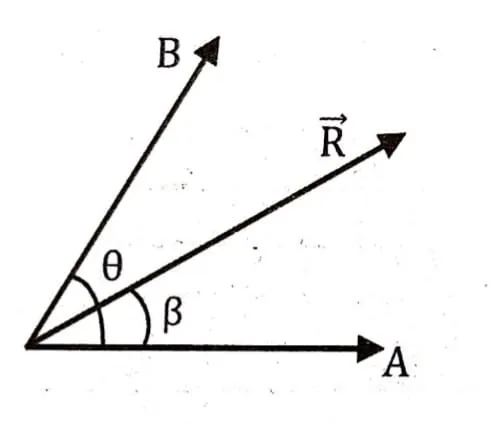
Direction of resultant tan⁡β=Bsin⁡θA+Bcos⁡θ\tan\beta = \dfrac{B\sin\theta}{A + B\cos\theta}
Magnitude of difference ∣A⃗−B⃗∣=A2+B2−2ABcos⁡θ|\vec A - \vec B| = \sqrt{A^2 + B^2 - 2AB\cos\theta}
Vectors A and B drawn from one point with angle θ between them, and their resultant R at angle β to A
Resultant R⃗\vec R of A⃗\vec A and B⃗\vec B

Dot & cross products

Scalar (dot) product A⃗⋅B⃗=ABcos⁡θ  ⇒  θ=cos⁡−1 ⁣(A⃗⋅B⃗AB)\vec A \cdot \vec B = AB\cos\theta \;\Rightarrow\; \theta = \cos^{-1}\!\left(\dfrac{\vec A \cdot \vec B}{AB}\right)
Vector (cross) product ∣A⃗×B⃗∣=ABsin⁡θ|\vec A \times \vec B| = AB\sin\theta
Area of parallelogram with sides AA, BB ∣A⃗×B⃗∣|\vec A \times \vec B|
Area of triangle 12 ∣A⃗×B⃗∣\tfrac{1}{2}\,|\vec A \times \vec B|
Volume of parallelepiped A⃗⋅(B⃗×C⃗)\vec A \cdot (\vec B \times \vec C)
Coplanar vectors A⃗+B⃗=C⃗\vec A + \vec B = \vec C
Perpendicular vectors ∣A⃗+B⃗∣=∣A⃗−B⃗∣  ⇒  θ=90∘|\vec A + \vec B| = |\vec A - \vec B| \;\Rightarrow\; \theta = 90^\circ

Rectangular components in 3D

Vector in 3D A⃗=Axı^+Ayȷ^+Azk^\vec A = A_x\hat\imath + A_y\hat\jmath + A_z\hat k
Magnitude A=Ax2+Ay2+Az2A = \sqrt{A_x^2 + A_y^2 + A_z^2}
Direction cosines cos⁡α=AxA,cos⁡β=AyA,cos⁡γ=AzA\cos\alpha = \dfrac{A_x}{A}, \quad \cos\beta = \dfrac{A_y}{A}, \quad \cos\gamma = \dfrac{A_z}{A}

Keep practising

More free worksheets

Try a class first. It’s free.

Book a free trial class and see how Priya teaches before you decide. No commitment.

Book a free trial class

Or send an enquiry from the contact form →

Vectors worksheet

Page 1 of 4

Download
Vectors worksheet, page 1 of 4Vectors worksheet, page 2 of 4Vectors worksheet, page 3 of 4Vectors worksheet, page 4 of 4