Class 11 Physics · Gravitation
Gravitation worksheet for Class 11 Physics
35 practice questions on Gravitation for Class 11 Physics (Gravitation), from Priya Jain (M.Sc. Physics, B.Ed.). Open the worksheet to view, print or download it, or read the questions below.
Section A · Multiple Choice
Choose the correct option. Questions 1–31
- 1
The value of the gravitational constant for two objects in vacuum is . Its value in a dense medium of density g cm will be:
- a
- b
- c
- d
- 2
If the radius of the Earth shrinks by 1% but its mass remains the same, then the acceleration due to gravity on the Earth’s surface will:
- a Decrease
- b Remain the same
- c Increase
- d Cannot be determined
- 3
At a certain place, the value of is 9.8 m/s². If a part of the Earth suddenly shrinks to half its size but the mass remains unchanged, then at that same place (assuming the distance of this place from the center of the Earth remains the same), the value of will be:
- a 4.9 m/s²
- b 9.8 m/s²
- c 3.1 m/s²
- d 19.6 m/s²
- 4
The change in the value of at a height above the Earth’s surface is the same as the change at a depth inside the Earth (where both and are very small compared to the radius of the Earth). Then:
- a
- b
- c
- d
- 5
Suppose a light planet revolves around a very massive star in a circular orbit of radius with a time period . If the gravitational force between the star and the planet is proportional to , then:
- a
- b
- c
- d
- 6
Two successive satellites of masses and are revolving in orbits of radii and respectively. If , then which of the following relations regarding the speeds of the satellites and is true?
- a
- b
- c
- d
- 7
The escape velocity for a rocket on Earth is 11.2 km/s. On a planet where the acceleration due to gravity is twice that of Earth and the diameter of the planet is twice the diameter of Earth, its value in km/s will be:
- a 11.2
- b 5.6
- c 22.4
- d 33.6
- 8
The escape velocity from the surface of Earth is 11 km/s. If the radius of another planet is twice the radius of Earth but its mean density is the same as Earth’s, then the value of escape velocity from that planet will be:
- a 12 km/s
- b 22 km/s
- c 5.5 km/s
- d 15.5 km/s
- 9
Two satellites A and B are revolving around a planet P in circular orbits of radii and respectively. If the speed of satellite A is , then the speed of satellite B will be:
- a
- b
- c
- d
- 10
The radius of the Earth is 4000 miles. At a height of 10 miles above its surface, the change in acceleration due to gravity will be:
- a
- b
- c
- d
- 11
If two objects of masses and revolve in circular paths of radii and respectively around their center of mass due to mutual gravitational attraction, then which of the following formulas will apply?
- a
- b
- c
- d
- 12
The escape velocity of an object of mass 1 kg on a planet is 100 m/s. The potential energy of the object on that planet will be:
- a −5000 J
- b −1000 J
- c −2400 J
- d −10000 J
- 13
The height of a geostationary TV satellite will be (where is the duration of a day and is the radius of the Earth):
- a
- b
- c
- d
- 14
Two objects of masses and () revolve in circular orbits of radii and () about their center of mass. The angular velocity of and the angular velocity of are related as:
- a
- b
- c
- d
- 15
The binding energy of the Earth–Moon system can be represented as:
- a
- b
- c
- d
- 16
In planetary motion:
- a Rotational kinetic energy remains conserved
- b Angular momentum remains conserved
- c Linear kinetic energy remains conserved
- d Potential energy remains conserved
- 17
If a planet of mass revolving around the Sun has an angular momentum , then the areal velocity (area swept per second by the line joining the planet to the Sun) will be:
- a
- b
- c
- d
- 18
A particle falls from infinity towards the Earth. Its velocity upon reaching the surface of the Earth will be:
- a Infinity
- b
- c
- d
- 19
If a person can jump 2 meters high on the surface of the Earth, then on a satellite where the acceleration due to gravity is 1.96 m/s², his jump height will be:
- a 5 m
- b 10 m
- c 20 m
- d 2 m
- 20
The ratio of kinetic energy to potential energy of a satellite is:
- a 1 : 4
- b 4 : 1
- c 1 : 2
- d 2 : 1
- 21
At a point located at a distance of 8000 km from the center of the Earth, the intensity of the gravitational field is 6 N/kg. The gravitational potential at that point is:
- a
- b J
- c J/kg
- d J
- 22
The escape velocity of a planet is . The value of escape velocity for a planet of the same density but twice the radius will be:
- a
- b
- c
- d
- 23
The speed of a 500 kg satellite at a height of km from the Earth is m/s. If the orbit of the satellite is circular, the gravitational force of the Earth on the satellite is:
- a
- b
- c
- d
- 24
The minimum energy required to launch a 250 kg satellite from the surface of the Earth into an orbit at a height of will be:
- a J
- b J
- c J
- d J
- 25
The ratio of the radii of two planets is and the ratio of their acceleration due to gravity is , then the ratio of the escape velocities of these planets will be:
- a
- b
- c
- d
- 26
Two bodies of masses and are dropped from the same height, then the ratio of their momenta at the surface of the Earth will be:
- a
- b
- c
- d
- 27
The percentage change in the weight of a body when moved from the equator to the poles on the surface of the Earth will be:
- a 4.5
- b 1.2
- c 0.43
- d 0.04
- 28
What should be the rotational velocity of the Earth about its own axis so that the weight of a body at the equator becomes of its present weight? (Radius of the Earth at the equator is .)
- a
- b
- c
- d
- 29
On Earth, the pressure of a barometer and the height of the column are pascal and 760 mm respectively. If it is taken to the Moon, the height of the column will be:
- a Zero
- b 76 mm
- c 126 mm
- d 760 mm
- 30
The escape velocity of a body from the Earth is 11.2 km/s. If it is projected at an angle of with the horizontal, the value of the escape velocity will be:
- a 11.2 km/s
- b 22.4 km/s
- c km/s
- d km/s
- 31
The figure shows the elliptical orbit of a planet relative to the Sun . The shaded area is twice the shaded area . If the time taken by the planet to move from to is and the time taken to move from to is , then:
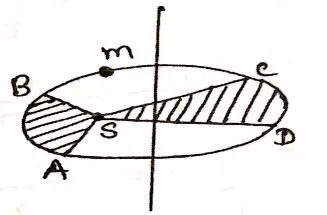
- a
- b
- c
- d
Section B · Short Answer & Numericals
Show all steps. Questions 32–35
- 32
A mass is divided into two parts, and . For a fixed distance between them, what should be the value of so that the gravitational force between the two parts is maximum?
- 33
The escape velocity of Earth is 11.2 km/s. Compared to Earth, the radius and mass of Mars are approximately half and 1/10th respectively. What will the escape velocity from Mars be?
- 34
Infinite masses, each of 1 kg, are placed along the x-axis at m, m, m, m, m, … What is the magnitude of the resultant gravitational potential at the origin (), in terms of the gravitational constant ?
- 35
A rocket is fired vertically with a speed of 5 km/s from the Earth’s surface. How far from the Earth does the rocket go before returning to the Earth? Mass of the Earth ; mean radius of the Earth ; .
Formula Sheet · Gravitation
Quick revision
Newton’s law of gravitation
| Force between two masses | |
|---|---|
| Gravitational constant |
Acceleration due to gravity ()
| At the surface | |
|---|---|
| (i) Due to the shape of the Earth | |
| (ii) At height | |
| At height , if | |
| (iii) At depth |
Effect of the Earth’s rotation on
| (iv) At latitude | |
|---|---|
| Poles and equator | |
| Weightlessness at the equator () | |
| Length of the day then | |
| For weightlessness, the Earth must rotate |
Variation of with distance from the Earth’s center
| Inside () | |
|---|---|
| Outside () |
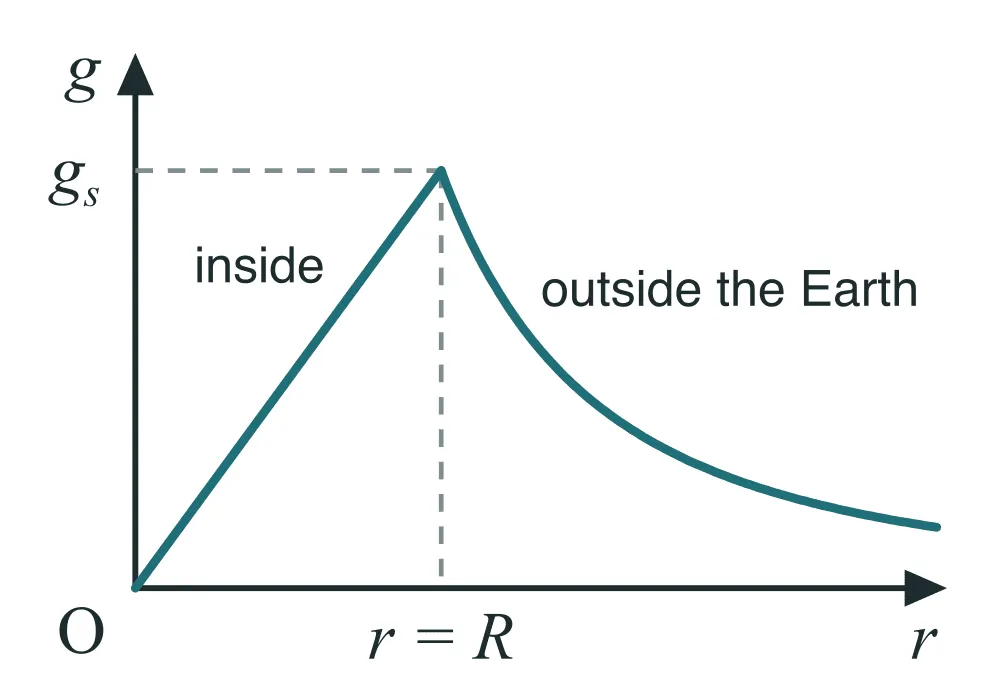
Gravitational potential: point mass & spherical shell
| Due to a point mass | |
|---|---|
| Shell, outside () | |
| Shell, surface () | |
| Shell, inside () |
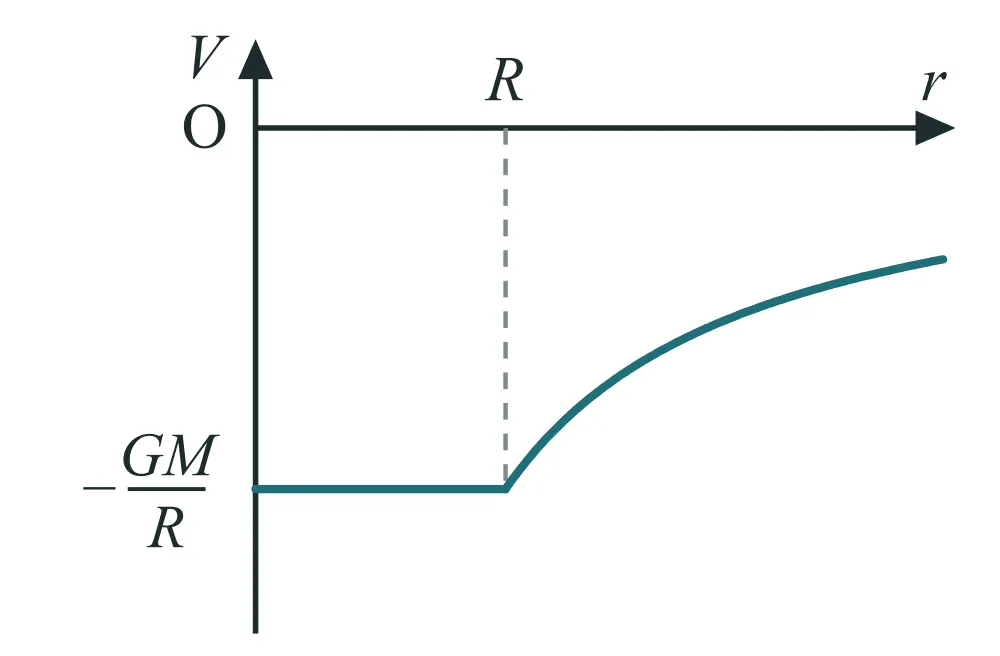
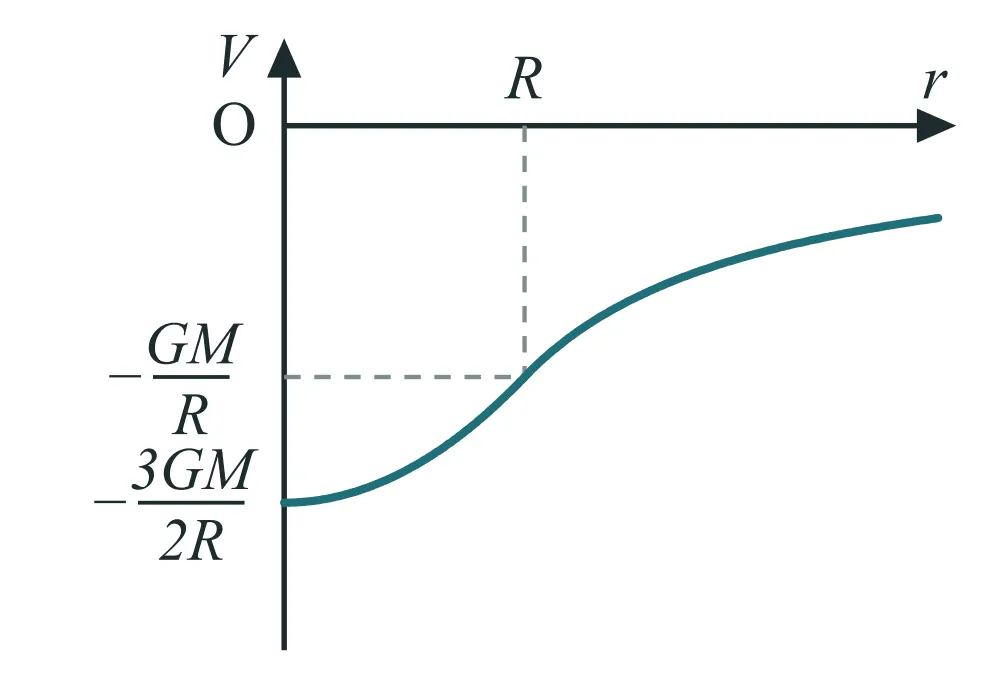
Potential due to a solid sphere
| Outside () | |
|---|---|
| At the surface () | |
| Inside () | |
| At the center |
Potential due to a thin ring
| At a distance on the axis | |
|---|---|
| At the center |
Gravitational potential energy ()
| Two point masses | |
|---|---|
| Uniform thin spherical shell | |
| Uniform solid sphere | |
| Change in P.E. | |
| At a height from the Earth’s surface | |
| Work done against gravity |
Escape velocity ()
| Escape velocity | |
|---|---|
| Maximum height attained by a body thrown with speed | |
| If (thrown faster than the escape velocity) |
Orbital velocity & path of a satellite
| For a nearby planet/satellite | |
|---|---|
| Spiral path | |
| Circular path | |
| Elliptical path | |
| Parabolic path | |
| Hyperbolic path | |
| If |
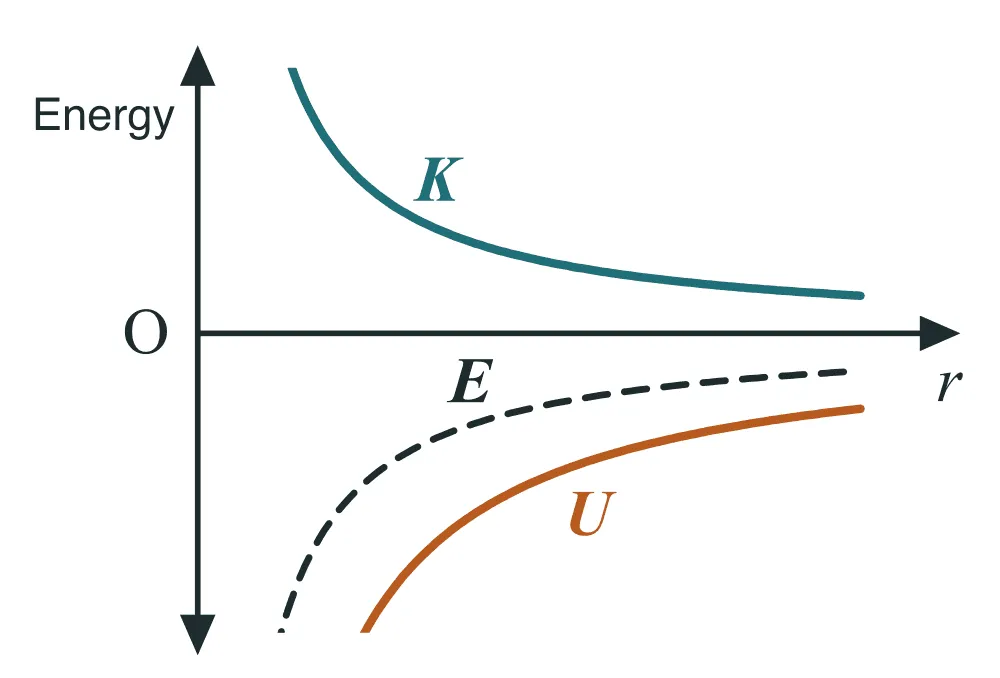
Energies of a satellite
| Potential energy | |
|---|---|
| Kinetic energy | |
| Total (mechanical) energy | |
| Binding energy | |
| Energy to shift its orbit from to (change in total energy) |
To make a satellite escape from its orbit
| Double its orbital kinetic energy | |
|---|---|
| Supply energy equal to its orbital energy (in magnitude) | |
| Multiply its orbital velocity by |
Kepler’s laws & time period of a satellite
| 1st law (law of orbits) | |
|---|---|
| 2nd law (law of areas): areal velocity | |
| 3rd law (law of periods) | |
| Velocity at aphelion | |
| Velocity at perihelion | |
| Time period (basic) | |
| Time period (expanded) |
Keep practising
More free worksheets
Try a class first. It’s free.
Book a free trial class and see how Priya teaches before you decide. No commitment.
Book a free trial class